
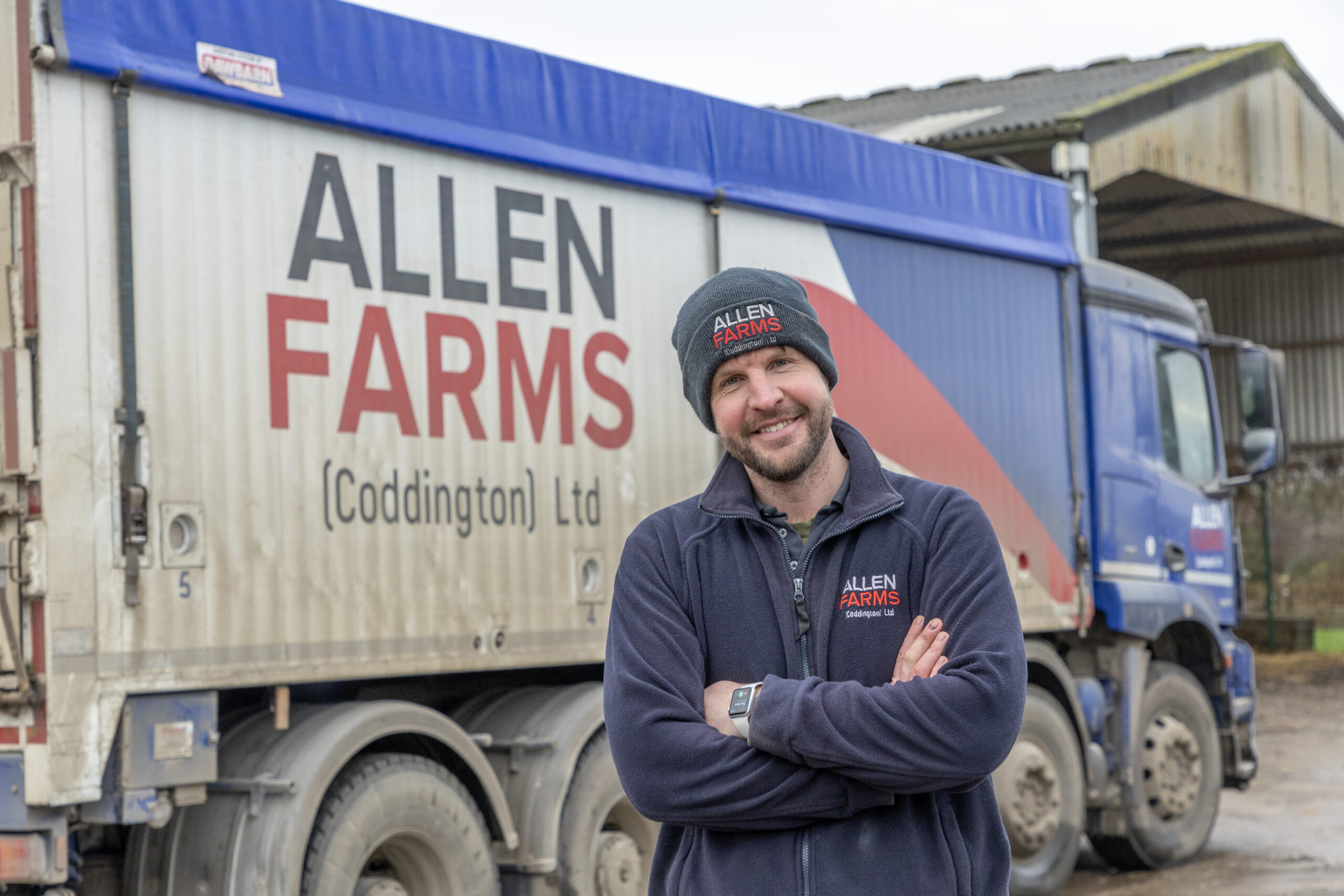
In just five years, Allen Farms at Coddington, near Newark, Nottinghamshire, has transformed its pig production enterprise from an outdoor operation to one that has adopted an indoor, deep litter environment aimed at boosting animal health and welfare.
“Migrating to an indoor rearing system was focussed on producing a consistent environment that would support healthier, happier sows,” explains Fred Allen, pictured, a director of the 1,200-acre family farm based at Newark, Nottinghamshire.
“We had two key objectives – develop the highest possible welfare standards for our livestock, and implement a reduction in the environmental footprint of our family-run farm,” he adds.
He says that the results have been better than expected.
“We’ve slashed outdoor emissions, and have also found ways to harness, store and utilise carbon, putting the business on-course to achieve our own carbon neutral targets within the next six-to-seven years,” explains Fred.
With the development of additional infrastructure and new buildings, the farm has been able to expand its herd from 550 to 850 breeding sows, increasing the quantity and quality of pork and bacon products it supplies to multi-national customers.
Cropping includes winter wheat, winter barley, spring beans and sugar beet, with all but sugar beet consumed on-farm as part of pig rations.
“All our home-grown cereals provide around 50% of our pig feed requirements, with the remainder sourced locally, which helps with quality assurance and traceability,” says Fred. “We carry out our own on-farm milling and ration production, and with a larger herd, we’re now creating a higher volume of manure, that goes back on the land.”
Allen Farms’ deep litter system has required more powerful machinery to improve productivity and efficiency, when cleaning sheds on a three-weekly cycle.
“Additional livestock buildings mean more work, so we opted for Kubota’s RT305, giving us more power with better lift and reach capacity than our previous compact pivot steer machine,” he says. “We can now empty sheds far more quickly, and with additional farm sites within a five-mile radius of our base at Drove Farm, the RT305 is self-sufficient when moving between pig units.”
Supplied by Henton & Chattell, the RT305T-2 is the largest telescopic wheeled loader in the Kubota range. The 66hp hydrostatic machine boasts a 1.2 tonne lift capacity and a maximum height of 4.3m and is comfortably on top of its workload at Allen Farms.
“While the bulk of the RT’s workload is on muck duties, we’ve also used it for bale stacking too,” says Fred. “It can handle three big square bales, and we can stack them seven high – which is as useful as a much larger and more expensive telehandler.”
Fred says that the farm’s previous pivot-steer loader clocked up 6,000 hours in five years, so the replacement machine had to stack-up with reliability and robustness that could withstand the daily requirements of a busy livestock operation.
“Kubota’s reputation for reliability and a decent warranty, meant the RT looked to be the most suitable and safest choice for our business,” he says. “And it’s been well-accepted by staff, with most citing how easy it is, to get on and off the loader.”
“Choosing a canopy version instead of a glazed cab does bring many benefits, including better visibility and it’s extremely easy to clean, which is very important given our strict bio-security regime.”
“We’re now in the process of finding more attachments to make full use of its hydraulic performance,” he says. “And a hydraulic sweeper brush is next on the list.”